When Claude Bans an Entire Company: Lessons from the SaaS Era
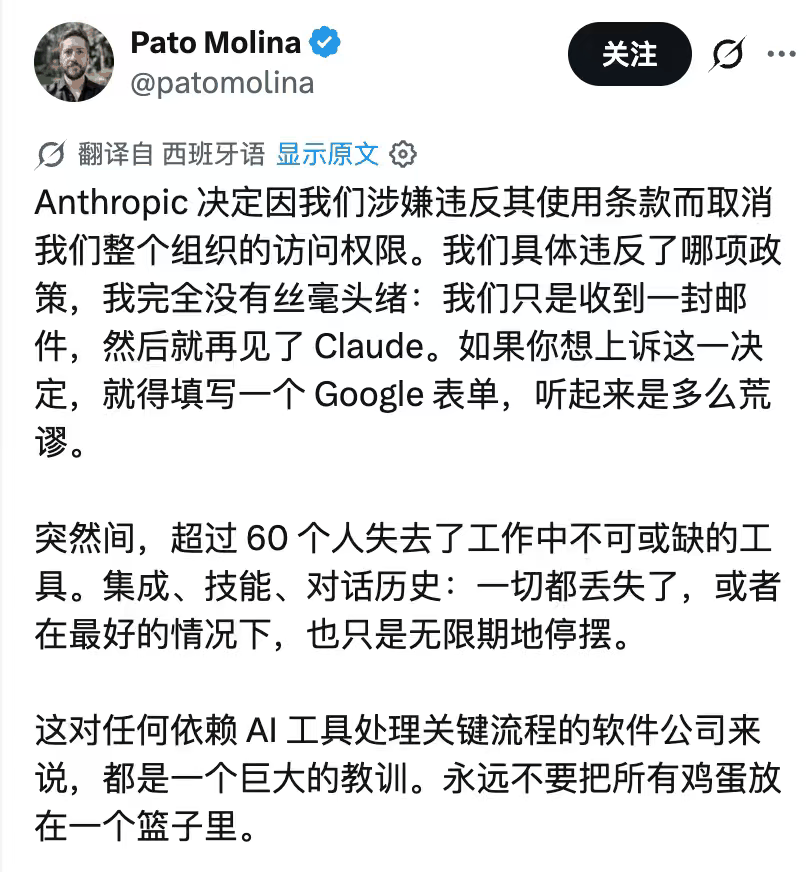
Recently, a tech entrepreneur on X shared a chilling tweet about their experience:
Anthropic decided to ban our entire organization’s access due to alleged violations of the terms of service. What exactly did we violate? I don’t know. We just received an email, and then Claude said goodbye. If you want to appeal, you have to fill out a Google form—sounds like a dark joke, right? Overnight, over sixty people lost the core tools they relied on for work. All integrations, customized skills, and months of conversation history… either permanently lost or indefinitely stalled. For any software company embedding AI into critical business processes, this is an expensive lesson: don’t put all your eggs in one basket.
Reading this, I first felt absurd, then a chill of reality. Not because Anthropic is particularly “bad,” but because such incidents are so reasonable and natural that any team currently using AI to reshape workflows could be the next victim.
1. A Cloud Execution Without Trial
Let’s review some of the most disheartening details of this incident:
First, the unknown charges. The email only stated, “allegedly violated terms of service.” Was there a prohibited word in the conversation? Did an API call trigger some automated security audit? Or did an employee using a VPN while on a business trip in Vietnam cause an IP anomaly? As a user, you never know where that bullet came from.
Second, the appeal mechanism is trivial. The productivity of sixty people came to a halt, and the lifeline of an enterprise client was cut off, yet the appeal process was a cold Google form. This wasn’t an email to a Customer Success Manager, nor a high-priority ticket in a support system, but a spreadsheet that might be processed by an intern every Friday afternoon. The disparity in experience is enormous: you invested data, budget, and trust to feed an “enterprise-level AI brain,” but in the eyes of the platform’s enforcers, you are no different from a newly registered free trial account.
Third, the instant evaporation of data assets. This is the most painful point. For teams heavily reliant on Claude, the accumulated architectural discussions in long contexts, the internal knowledge base built using the Projects feature, and the complex agent workflows created via API are not just “chat records”; they are the company’s brain, growing on someone else’s server without backup. Once the account is killed, it’s not just a matter of “switching to another model and asking again”; it’s brain death.
2. Why Do Large Model Vendors’ Terms Resemble “Pocket Crimes”?
This entrepreneur’s experience is not an isolated case. Last year, OpenAI also faced large-scale bans of developer accounts and ChatGPT Plus users being banned without cause. In the era of large models, terms of service (ToS) are increasingly morphing into a vague, one-sided, and nearly unlimited interpretation of rights.
The black-boxing of content safety: Vendors must address regulatory pressures and ethical inquiries, which is understandable. However, current AI safety strategies increasingly rely on automated inspections. A normal code review conversation that happens to include a segment reproducing a vulnerability could be misjudged as “hacker training.” A discussion about scriptwriting that involves murder plots might trigger the “violent content” red line. When AI is more sensitive than humans and humans have no manual review rights, wrongful convictions are almost inevitable.
The exclusivity of business models: Many ToS implicitly prohibit “excessive automation,” “data scraping,” or even “development of competing models.” For a software company refining AI-native products, the boundary between normal high-frequency API calls and “abuse” is determined solely by the algorithms on the vendor’s backend.
When you build your production environment on someone else’s “moral intuition” and “automated rule engine,” you are essentially running naked.
3. A Bloody Warning for All AI Era Software Companies
This is not an article discouraging the use of Claude. Claude remains a powerful tool for coding capabilities and long text processing. However, this incident serves as a powerful wake-up call for all teams diving into AI: we must treat model vendors’ “account-level disasters” with the same seriousness as a power outage in a server room.
Based on this lesson, here are some potentially life-saving suggestions:
First, decentralized architectural dependencies.
Don’t let your agent rely solely on the Claude API. On the engineering side, ensure you establish an LLM gateway and fallback mechanism. If your core function is code generation, when Claude goes down, the system should automatically (or with one click) switch to GPT-4 or DeepSeek. Even if the downgraded performance is only 80%, it is far better than throwing a 500 Error and a link to a Google form.
Second, self-rescue of data sovereignty.
Don’t leave your only knowledge base in Claude Projects. Conversation history, prompt templates, and system prompts must be stored externally. Every valuable output should be real-time saved to your own database or vector store via API. While losing contextual coherence is painful, at least you leave behind “memory fossils,” preventing a complete restart.
Third, redundancy strategies for organizational accounts.
If possible, do not bind the entire organization to a single enterprise account. Even if it’s a bit cumbersome, core members’ API keys should ideally be logically isolated through different project entities, payment sources, and IP exits. The first step to diversifying your eggs is to have multiple different baskets of purchase credentials.
Fourth, include “what to do if banned” in your emergency plan.
This is no longer alarmist. The reliability of current AI infrastructure (LLM Providers) is far lower than that of IaaS giants like AWS/Azure. As decision-makers, you must assume this will happen and then reverse-engineer: if you wake up tomorrow and Claude has vanished, how long can my development pipeline, customer service system, and content production process last? Four hours? Or four minutes?
4. Not Just Anger, But a Call for More “Mature” Business Contracts
Lastly, I want to say a few words to Anthropic and all AI platforms.
We all know you bear immense pressure regarding safety alignment and that automated bans are the only choice when facing a massive user base. However, the essence of B2B business is trust, not charity.
When a company of sixty entrusts its fate to your API, they are not just buying tokens; they are purchasing a business contract. This contract requires you to provide a specific charge before pulling the plug; when cutting off income sources, offer a way to reach someone by phone for appeals. Using a Google form to handle enterprise-level disasters should not be the standard of a top Silicon Valley AI lab.
Never overestimate the platform’s kindness, and never underestimate the fragility of data. In this era of AI exploration, a multi-cloud strategy is not an option; it is a survival instinct.
Comments
Discussion is powered by Giscus (GitHub Discussions). Add
repo,repoID,category, andcategoryIDunder[params.comments.giscus]inhugo.tomlusing the values from the Giscus setup tool.