Introduction
In an unassuming building in North Beach, San Francisco, a company is quietly changing the rules of software development.
Cursor, the most talked-about AI unicorn of the past year, started from scratch and achieved a $100 million ARR in less than two years. Its workforce expanded from a handful to nearly 250 employees, and its products are utilized by top developers worldwide, redefining the standards for “development tools.”
Tech writer Brie Wolfson initially visited Cursor to see what made the team different but soon found herself drawn in: notebooks, job descriptions, and Slack invites flooded in as Cursor wanted her to “tell their story.”
 Cursor Office | Source: Colossus
Brie agreed, stating, “Having worked in the early stages of Stripe and Figma, I sensed the ‘magic’ in the air again at Cursor. If you’ve experienced that feeling, you know how addictive it is.”
In her view, no truly “epoch-making company” has emerged in this AI era, but Cursor appears to have that potential.
She was curious about the new company paradigm the leadership aimed to establish, how Cursor’s culture formed, and wanted to participate in shaping it.
Thus, her firsthand account, “Inside Cursor: Sixty Days with an AI Unicorn,” was born, capturing the genuine rhythm of Cursor, the creativity of its young team, and a unique culture driven by its mission.
Over two months, Brie validated some expectations but was also shocked by others, such as the fact that at Cursor, the 996 work schedule is genuinely voluntary.
Key Points:
- When I asked the co-founder what his biggest concern was, he said, “If people start talking about the weather at the dinner table, then I should worry.”
- At Cursor, everyone is HR; everyone is recruiting talent.
- Cursor does not design for “fool-proofing” because there are no “fools” here.
- When a task is assigned to someone, they have full responsibility and autonomy, regardless of their position.
- Cursor employees are possibly the most immersed in their own product in the world.
- At Cursor, critics are also problem solvers; criticism is participation.
- As a product for AI programming, Cursor views users not as “customers” but as peers.
- They treat every line of code as an attempt to sculpt the world, with the ensuing commercial success being just a reward.
- The young workforce, formed in less than two years, has a spirit and demeanor that is “very mature.”
01
The Culture of Cursor
Strictly speaking, Cursor does not belong to Silicon Valley; its headquarters is located in North Beach, San Francisco, an area with few other startups.
The Cursor headquarters is as understated as a university cafeteria, with no logos at the entrance, no corporate posters on the walls, and few employees wearing Cursor T-shirts or stickers on their laptops.
The office mainly consists of people sitting at desks working or discussing in small groups.
Instead of whiteboards, blackboards hang on the walls, and the furniture consists of European antiques sourced from a retired tech enthusiast in the Bay Area. The walls are lined with books, many of which are textbooks, alongside numerous worn-out covers and spines, indicating they have been genuinely read.
In Brie’s words, “It’s not polished, but it’s sincere.”
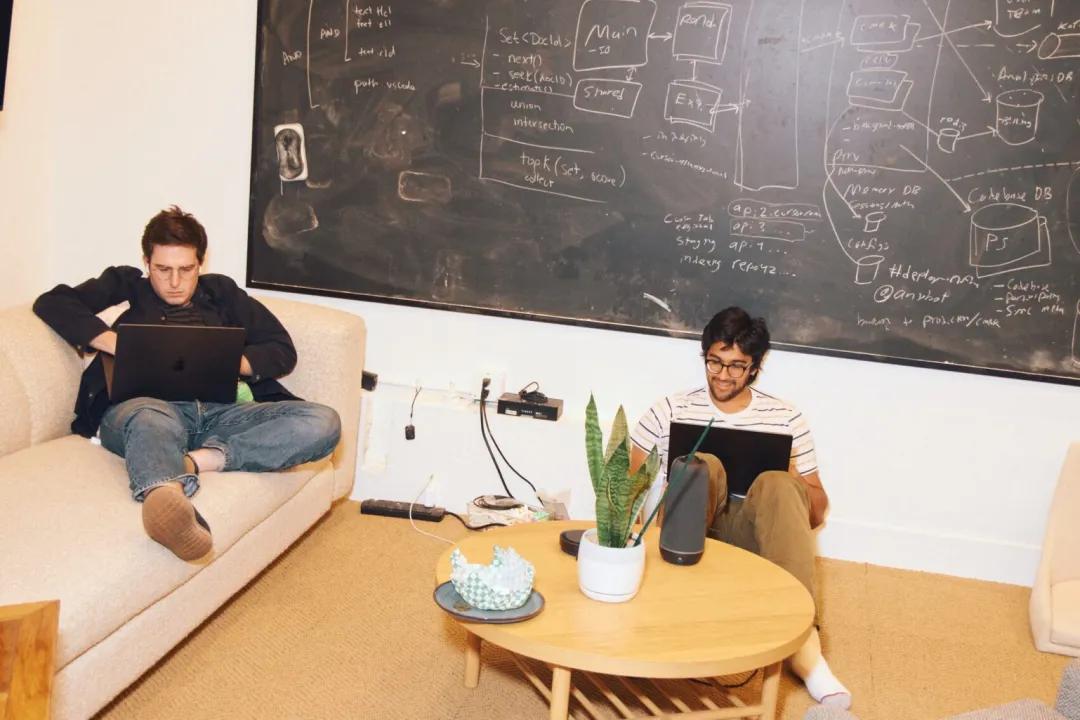 Cursor employees enthusiastically brainstorm on blackboards | Source: Colossus
Cursor does not subscribe to the online work model; it is almost entirely face-to-face: 86% of employees are based at the San Francisco headquarters or the new office in New York. At Cursor, the most effective communication method is not sending Slack messages or scheduling meetings, but directly walking to someone’s desk and tapping them on the shoulder, as Cursor puts it: “We are more of an oral culture company.”
In fact, this emphasis on face-to-face office work has overturned Brie’s previous perceptions, and she had to admit that the fluidity of in-person work is much higher: “The offline chemistry is indeed addictive.”
Collaboration within the company mostly occurs in spontaneous discussions around blackboards or desks. However, Cursor is very restrained when it comes to meetings, scheduling very few, as they place immense importance on “deep work time.”
Even the chef at Cursor enjoys “high autonomy.”
Every day, the company chef Fausto prepares lunch for everyone, and all gather at a long table to eat together. Rumor has it that he once considered quitting because creating menus for a team that doubled in size daily was exhausting, but someone on the team created an AI menu generator to help him brainstorm, and now he shares recipes and takes orders via Slack.
Conversations at lunch and dinner tables often revolve around work ideas, allowing everyone to understand each other’s current projects, ideas they are pondering, or predictions about the future of products and industries.
When Brie asked co-founder Sualeh Asif what his biggest concern was, he thought for a moment and replied, “If people start talking about the weather at the dinner table, then I should worry.”
02
The “Hunter Culture” of Cursor
If Cursor’s culture is built on face-to-face interactions, its growth relies on “hunting talent.”
In Brie’s description, Cursor’s recruitment system completely defies convention: “They view the smallest unit of hiring as a person, not a position.”
In most companies, recruitment follows a process: identify capability gaps, write job descriptions, screen resumes, conduct interviews, extend offers, and wait for onboarding.
But at Cursor, the process resembles a social hunt. Someone throws a name into the Slack #hiring-ideas channel, noting, “This is a particularly impressive person,” and the entire team immediately begins the hunt.
They brainstorm to identify what the person excels at, what they enjoy doing, and what role would suit them best. If there’s mutual interest, that “candidate” might show up in the office by Monday, just like Brie did.
Once they identify a target, the team creates a new Slack group to collectively strategize how to approach the person.
Their discussions are highly detailed: “What is this person most passionate about?” “What are they a genius at?” “What challenges can Cursor offer them?”
Because at Cursor, the assumption is that “the best people love challenges.”
 Cursor employees | Source: Colossus
Another well-known tactic within Cursor is to invite the person to “just come by the headquarters for a visit.” They seem very confident in Cursor’s office culture, believing that once the person steps inside and feels that energy, it’s hard not to be tempted. This has already been validated by Brie.
Their talent acquisition methods are also unique. For instance, Swedish engineer Eric Zakariasson was recruited because he had previously held a Cursor workshop in Stockholm; engineer Ian Huang joined because he was coding with Cursor until the early hours every night.
When other companies are laying off or new startups are dissolving, Cursor’s Slack channel often sees messages like, “New Computer has dissolved; let’s see if there’s anyone we want.”
This style resembles the early “PayPal Mafia,” where everyone is both a hunter and a referrer. Cursor employees are encouraged to “scout for talent,” making recruitment a company-wide initiative rather than just an HR responsibility.
As a result, Cursor’s size exploded within a year: from fewer than 20 people last year to nearly 250 today.
Even with this rapid growth, Cursor’s acceptance rate remains incredibly low. The leadership personally reviews every hiring decision, believing in the mantra, “Better to miss out than to hire the wrong person,” but those chosen by Cursor will find ways to join.
For example, a former designer from Stripe and Notion, Ryo Lu, is an Apple fan. Cursor impressed him by acquiring an early Macintosh to gift him; German engineer Lukas Möller declined the first invitation, prompting co-founder Oskar to fly to Germany a year later for a second visit; another candidate, Jordan MacDonald, had Cursor schedule six months of coffee meetings, and when they learned she had just moved, they secretly contacted her interior designer to gift her an espresso machine. All three are now official Cursor employees.
This hunter culture has also resulted in an exceptionally high talent density at Cursor, shaping all subsequent operations: high trust, high pace, and zero nonsense.
03
No Fools and “Young People”
At Cursor, the talent density is so high that it almost feels unreal. Brie used a lengthy equation to describe their success formula:
“Engaging mission + hardcore technical challenges + winning + excellent recruitment = extraordinary talent density.”
If you’ve been in Silicon Valley, you know this statement is not just hyperbole; “talent density” is almost a bible for every company, and Cursor has turned it into a belief.
Cursor has a staggering statistic: there are 50 former founders (one-fifth of the total workforce) within the company, and 40% hail from MIT, Harvard, Columbia, Carnegie Mellon, Stanford, Berkeley, Yale, etc. Yet no one boasts about their alma maters; as Brie puts it, “They are all experts, but no one shows off.”
Moreover, Cursor is the first job for many employees, which left Brie impressed with the age distribution at Cursor.
She previously thought that when people referred to a colleague as “too young,” they were either implying that the person was somewhat unreliable or that, while capable, they were difficult to communicate with.
However, the young people at Cursor are different; they dress appropriately, have sincere eyes, speak clearly, and are polite. During discussions, they often reference history, art, pop culture, Silicon Valley history, or experiences from other industries.
This is also one of Brie’s favorite aspects of Cursor: it has a spirit that is “very mature.”
The young workforce does not indulge in internet slang or meme culture, nor do they discuss trending topics or workplace gossip. Even non-work-related discussions in work groups revolve around local cultural events in San Francisco, critiques of AI opinions from The New Yorker, or sharing tips on “how to properly fold a sheet.”
Moreover, this group of young people exhibits stable emotions. In Slack, the most commonly used emoji among Cursor employees is ❤️.
Brie recounted an incident she witnessed: during a severe outage caused by a system failure, the culprit publicly apologized in the Slack #general channel, and the channel was flooded with ❤️, with comments like “Risks are inevitable; let’s do better next time.”
“No one raises their voice, no one loses their cool, and no one panics over mistakes,” Brie wrote. But this does not mean they are lax; their calmness stems from a shared belief in each other’s professionalism and dedication, so mistakes do not trigger internal strife but rather prompt improvement.
Cursor resembles a utopia that stands in contrast to Silicon Valley: a fast-paced company that maintains an almost Zen-like calm.
Many visitors remark, “Your company is so calm.” Employees respond, “That’s just the appearance; underneath, it’s like a duck gliding on water.”
This phrase encapsulates the atmosphere at Cursor: serene on the surface, with frantic paddling beneath.
The “maturity” of each employee is also reflected in their approach: they study the world through action rather than relying solely on personal experience to generate ideas.
For instance, many employees in Cursor’s Slack create their own “brainstorming channels” (#brain-XXX), where they share thoughts, inspirations, or observations, such as “Is CMS a relic of the pre-AI era?” “A long list of insights after a client visit,” or dissatisfaction with a new feature.
There are no KPIs or expectations for responses, but if you write something interesting and insightful, you will naturally attract a group of “readers.” This fosters an “open-source thinking culture” where everyone iterates their understanding publicly.
Brie also observed a steep staircase in the office without handrails. When she asked why, the response was, “Humans know how to climb stairs.”
This statement epitomizes Cursor’s talent philosophy: We do not design for “fools” because there are no “fools” here.
 Cursor Office | Source: Colossus
With such intelligent and mature talent coming together, Cursor has created a “paradise for individual contributors.”
Individual contributors (ICs) are highly valued at Cursor and regarded as the highest status role. At Cursor, ICs are driven by passion rather than commands from leadership. The working style here is very “IC”: whoever is most invested in a task takes it on; when a task is assigned to someone, they have full responsibility and autonomy, regardless of their position.
For instance, there was a proposal to run Cursor in the browser. Four engineers immediately agreed and worked on it over the weekend. As one of them put it, “We dropped everything and went into full focus mode until it was done. This was one of the most enjoyable work experiences of my life.”
Such situations happen regularly at Cursor.
04
No 9-9-6, Only Self-Driven Passion
In the tech world, Cursor is rumored to have an “incredible work intensity,” with many privately suggesting they practice 996. However, Brie states that this is actually a counterintuitive misunderstanding:
“The company does not require employees to work 996; however, a significant portion of the team loves what they do so much that they overcommit, and the workload is entirely self-imposed.”
Even Brie was influenced by this atmosphere, writing, “No one asked me to work evenings or weekends. But I just wanted to. I’m even writing this on a Saturday while my ten-month-old is sleeping upstairs.”
This working state is almost akin to the intoxication of a craftsman creating a piece: there are no KPIs or institutional demands, only the drive to “make things better.”
But Brie also admits that she nearly drowned in the pace during the first few weeks, with new problems, priorities, and tasks arising daily. Working overtime did not resolve the issues; rather, she was uncertain about the correctness, value, and reporting of her work results.
Almost every new employee experiences this “drowning feeling.” But they soon realize that this is actually the company’s trust in them: “Once you truly understand this, panic gradually transforms into confidence,” Brie wrote.
 Cursor Office | Source: Colossus
This is also a typical “Silicon Valley growth curve”: throwing newcomers into deep water, and they discover they can swim.
Moreover, Cursor employees are possibly the most immersed in their own product in the world. The only ones who might rival them are those at Apple, who use their own Macs and iPhones daily.
Everyone at Cursor uses Cursor to write code, edit documents, and experiment with new features. They are both developers and users, which leads to a bottom-up product roadmap: if you want a feature to exist, that is enough reason to develop it.
When an employee is convinced that a feature is worth building, they might present it at the weekly product demo or just dive in and start working on it.
Sometimes, two employees might develop the same feature, and the final version will incorporate the best ideas from both sides.
Once development is complete, they first launch the feature in an internal version of Cursor. The team tests it internally to see if it “has life”: if everyone loves it, they keep and refine it; if no one cares, it naturally gets eliminated.
Feedback is very “Cursor-like”: everyone votes using emojis in the Slack channel, 🟢 = remove feature, 🔴 = feature is useful. Everyone makes their choice in seconds, but it often sparks lengthy and deeper discussions.
Many of the currently most popular features, such as Tab, CmdK, Agent, Bugbot, and Background Agent, have grown this way.
At Cursor, it is commonplace for people to challenge and question colleagues’ work results. Here, your ideas, code, and writing can be dissected by colleagues at any time.
But this is not hostility; it is a form of trust: everyone believes you can handle criticism and are willing to improve.
Cursor’s top developers are very aware of what constitutes a good product, so they are extremely sensitive to “subpar” offerings. They don’t just give feedback; they often “roll up their sleeves” and help out. This also shapes Cursor’s culture of “criticism as participation.”
Like all cultures, this “friction-based communication” has grown from the founders themselves.
Michael (co-founder) often encourages everyone to ask “spicy questions” during company-wide Q&A sessions, while another founder, Sualeh, is more direct: he privately messages employees asking, “What are you worried about?”
They want employees to always carry a “curious anxiety” rather than a “safe numbness.” Of course, such a culture has potential dangers.
Brie candidly states: if arrogance, office politics, emotional instability, and poor communication infiltrate this culture, it can quickly become toxic.
She has seen many genius-level individuals, but they “treat fault-finding as a sport without a genuine desire to fix things.” However, at Cursor, critics are also problem solvers; everyone sincerely hopes to achieve the best for the product and each other.
05
Everyone is Creating Something at Cursor
Cursor’s attitude towards product philosophy is also one of high confidence.
Brie summarizes it succinctly: other companies focus on lowering barriers to entry, enabling more people to get started, but Cursor focuses on raising the ceiling of functionality. They believe that only when the top users are elevated will the entire ecosystem’s standards be raised.
In addition to vertically raising the ceiling, Cursor encourages exploration of product breadth.
Beyond the engineering team, sales, operations, and marketing teams also use Cursor to build internal tools, websites, or scripts. The #built-with-Cursor channel showcases new projects daily, such as a court reservation mini-program, a wedding website for an employee, a game that feeds virtual snacks to the office dog, and a quiz about the Metropolitan Museum of Art’s collection.
This model, where everyone loves to use the product, everyone gives feedback, and everyone votes on product direction, has also shaped a unique company ritual at Cursor: Fuzz, a collective celebration that pushes perfectionism to the limit.
Whenever a major version is about to be released, whether it’s a client update or a website overhaul, Cursor holds a Fuzz event, calling everyone to come out and find bugs.
 Cursor’s work culture encourages action anytime, anywhere | Source: Colossus
As a product for AI programming, Cursor does not view users as “customers” but as peers. They believe that if the tools are laggy or crash, it wastes their time. Therefore, they must avoid all bugs as much as possible before launch.
As stated in Cursor’s early documentation, “Be responsible for bugs. Bugs are inevitable, but bugs that reach the user are disappointing. We want users to program with Cursor every day; bugs or performance issues are the easiest reasons for them to switch platforms.”
The atmosphere during Fuzz resembles a ritual. Once everyone gathers, engineers form a circle, sitting if possible, or sitting cross-legged, leaning against walls, or even sitting on the backs of chairs.
The product lead shares the link to the latest build and testing instructions in Slack, and the sound of typing fills the room as everyone works hard to find bugs, interface flaws, logical errors, or edge cases.
They continuously record issues in the Slack channel, occasionally sparking debates, and even initiating instant votes to determine which solution is more elegant.
The entire process lasts an hour, resembling a hacker’s version of meditation: collective silence, extreme focus, and no nonsense. The results of Fuzz typically culminate in a lengthy list of “all the issues to fix before the next day’s release.”
After Fuzz, the product team expresses gratitude to everyone and then embarks on a long night of fixes, with those who identified issues often staying behind to help.
In other companies, testing and development are often two separate groups, but at Cursor, those who find problems and those who fix them are often the same group of people.
06
Mission as Reward
Brie mentioned that she once asked co-founder Michael, “What kind of feeling do you want the company to evoke?”
Michael did not answer directly but instead asked her, “Have you seen the Beatles documentary?”
In this documentary, the most famous band locks themselves in a recording studio for three weeks, iterating and experimenting continuously until they create “Let It Be.”
Brie believes this perfectly describes Cursor’s culture: there are no excessive strategies or lengthy slogans; everything is about continuous trial and error, collision, and adjustment in actual work. Just as band members constantly try and adjust every note, Cursor employees are continually refining every line of code and every detail of the product.
What the Cursor team truly cares about is not the “developer productivity” boasted on the company website or external press releases, but the code itself and how code and software become the infrastructure of the world.
They connect their work to street traffic lights, scientific analyses, medical records, supermarket inventory systems, and even flight control systems, treating every line of code as an attempt to sculpt the world.
This mission-driven culture has made Cursor’s commercial success a reward rather than the primary goal.
 Cursor Office | Source: Colossus
Brie noted that when the company reached $100 million ARR, hearts and 💯 emojis naturally popped up in the Slack channel, but the office remained calm as everyone continued discussing the product.
This also explains why, at Cursor, few people talk about wealth or future plans. As Brie summarizes: for employees, the true reward is seeing their work directly drive better and more precise software development, rather than external wealth or status.
It seems that for Cursor employees, the meaning, challenges, and sense of achievement in their work are the most direct and tangible rewards.
Cursor is shaping the world through work itself, believing that every aspect of software development, from coding to testing to deployment, will be “intelligently” restructured.
The term “programming” is also beginning to transcend the programmer alone: it now includes designers, product managers, entrepreneurs, and even industry experts.
This means the market potential is nearly limitless, and every line of code can change some aspect of our daily lives.
Comments
Discussion is powered by Giscus (GitHub Discussions). Add
repo,repoID,category, andcategoryIDunder[params.comments.giscus]inhugo.tomlusing the values from the Giscus setup tool.