What is OpenClaw?
Imagine having a new colleague who is highly capable, never takes credit for your work, and is available 24/7. That’s OpenClaw (often affectionately called “Little Lobster AI”). It is essentially an open-source AI agent framework created by Peter Steinberger in November 2025.
Its positioning is clear: not a “consultant”, but an “employee”. While consultants only offer advice, employees roll up their sleeves and get the job done. OpenClaw is that employee who can directly help you solve problems.
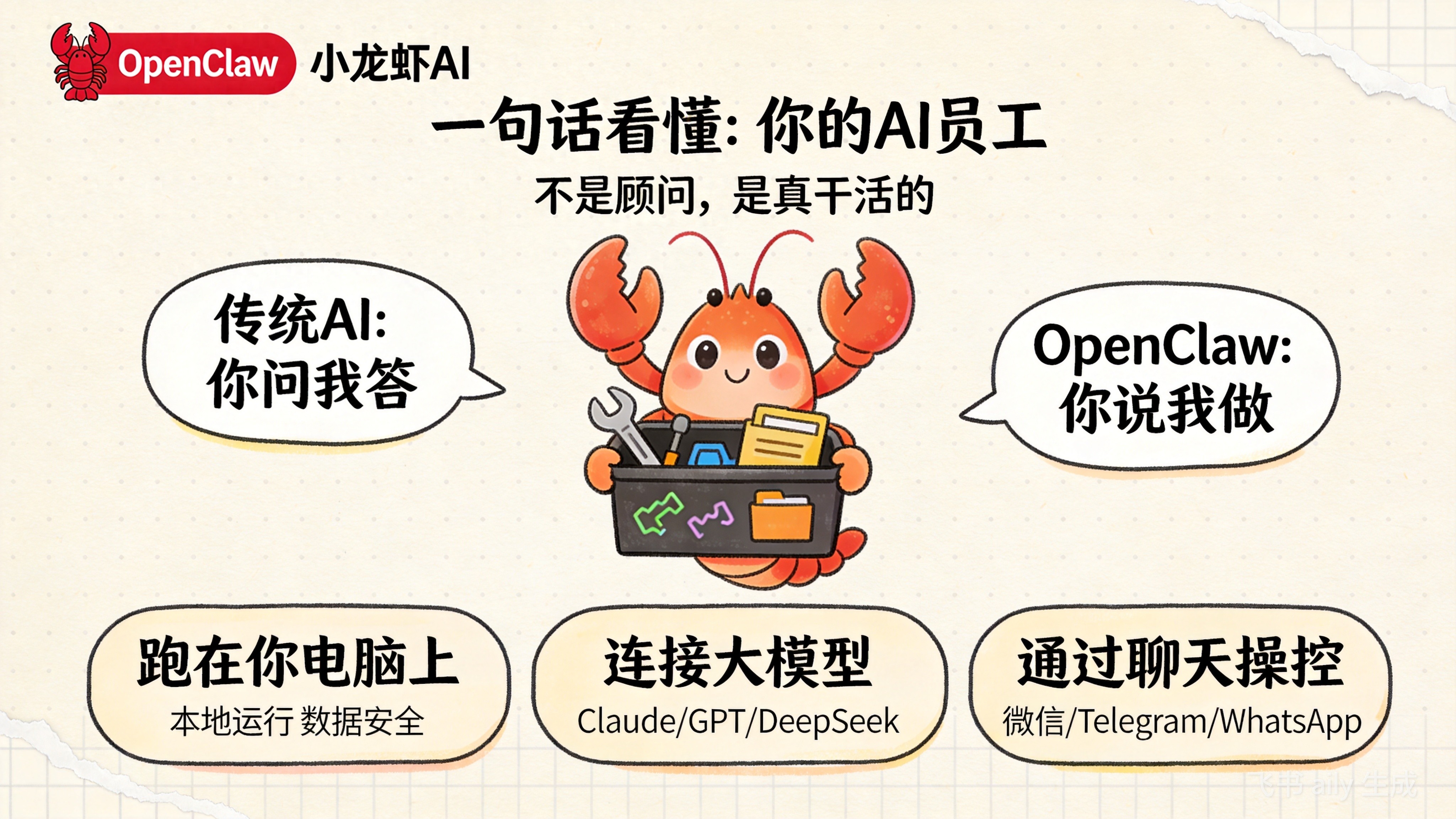
Key Points to Understand Quickly:
- Local Operation, Privacy Assured: It runs on your own computer, Mac, or server, keeping all data local and not uploading it to any cloud. This means your company files and personal information are very secure.
- Controlled via Chat Apps: You don’t need to open complex software. Simply chat with it through tools you use daily like WeChat, Telegram, or Discord, and it will start working.
- Completely Free and Open: It is licensed under the MIT open-source license, meaning anyone can use it for free, modify the code as needed, and even use it for commercial projects.
- About the Name: It was previously called ClawdBot and Moltbot, but due to trademark issues, it was ultimately named OpenClaw. The name isn’t important; what matters is its capabilities.
In short, OpenClaw is a tool that allows you to command AI to perform actual computer operations using natural language.
What Can OpenClaw Do?
While the previous section introduced “who it is,” this section showcases “how capable it is.” The core of OpenClaw is its execution power, allowing it to take on various roles in your workflow.
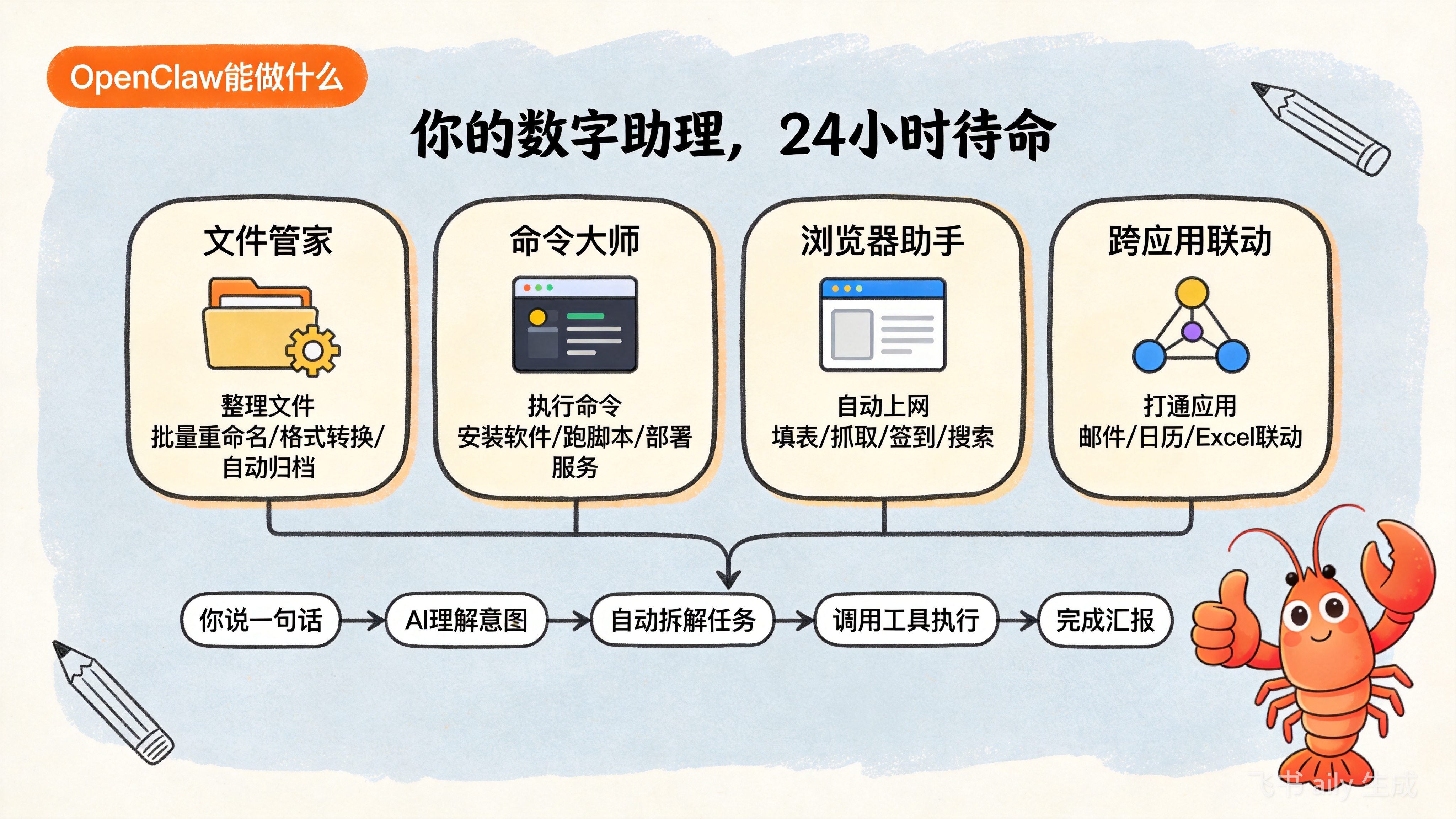
Its Core Superpowers Include:
- File Manager: Automatically rename hundreds of files, convert image or document formats, and organize chaotic files according to rules.
- Command Master: Install software, run scripts, troubleshoot system issues, and manage services on servers, acting like an on-call operations expert.
- Browser Assistant: Automatically fill out web forms, check in at scheduled times, scrape information from specified web pages, and perform intelligent searches.
- Office Helper: Automatically send and receive emails, manage calendar schedules, and handle data in Excel spreadsheets and Word documents.
- Intelligent Planner: You can give it complex requests, like “prepare materials for next week’s department meeting,” and it will break it down into tasks like “gather materials, write PPT, send meeting invites, book the meeting room,” and execute them step by step.
- Memory Partner: It remembers your preferences and habits, becoming more attuned to your needs over time, making it more considerate when handling similar tasks in the future.
- Versatile AI: It supports connections to various large models like Claude, GPT-4, DeepSeek, Kimi, and can also use locally deployed models, offering high flexibility.
Here are some real scenarios to illustrate its capabilities:
“Help me organize all screenshots on my desktop into folders named ‘2025-11-Project A’.” “Set up the Node.js development environment on my new computer and check which ports are occupied.” “Generate a chart report from this quarter’s sales data, email it to Mr. Wang by 3 PM, and automatically archive it in the ‘Quarterly Reports’ folder.” “Every weekday at 9 AM, scrape headline news from my favorite tech websites and send a summary to my Telegram.”
It lowers the barrier to “automation,” replacing programming with conversation.
Why is OpenClaw So Popular?
OpenClaw’s popularity is phenomenal; the numbers don’t lie: it has garnered over 248,000 stars on GitHub, surpassing even Linux, making it one of the most popular open-source projects in GitHub’s history. The community has contributed over 13,000 skills (plugins). Major domestic tech companies have quickly followed suit, launching similar products like Tencent’s QClaw, ByteDance’s ArkClaw, Alibaba’s CoPaw, and Huawei’s Little Yi.
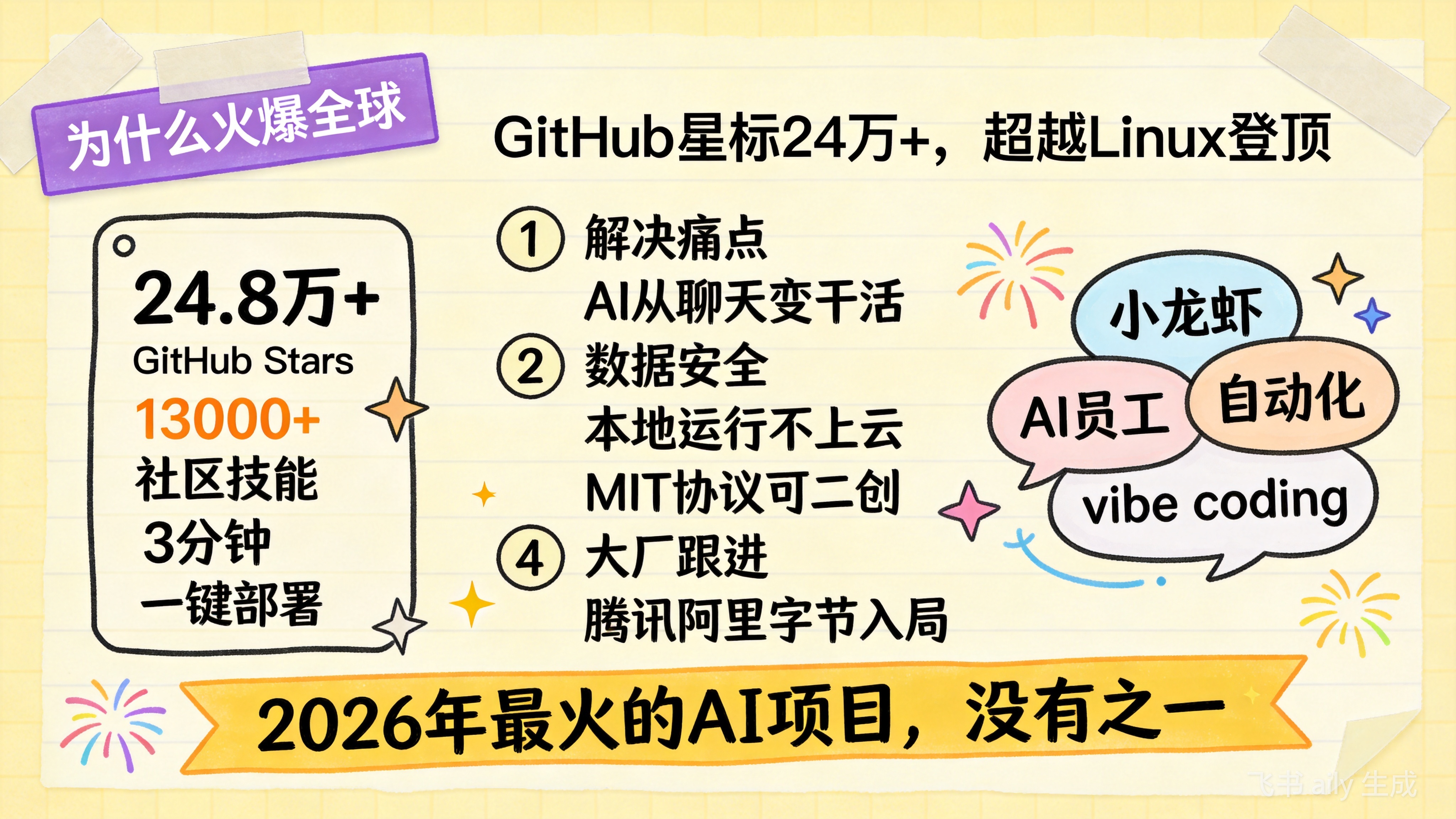
It precisely addresses the pain points of current AI applications: we are tired of AIs that only chat and give advice; what we truly need is a smart assistant that can execute tasks and free our hands.
Specifically, the reasons for its popularity include:
- Addresses Core Pain Points: It transforms AI from a “think tank” to “labor,” achieving a qualitative leap from “talking” to “doing.”
- Strong Sense of Data Security: Its fully local operation mode eliminates concerns about sensitive data being uploaded to the cloud, making it particularly appealing to enterprises and privacy-conscious users.
- Attractiveness of Being Open Source and Free: The MIT license grants it significant freedom and zero-cost advantages, attracting global developers and businesses to participate in its ecosystem.
- Rich Ecosystem: With 13,000+ community skills covering programming, office tasks, design, marketing, and nearly all common scenarios, it is ready to use and becomes more powerful with use.
- Strong Industry Endorsement: In February 2026, founder Peter Steinberger joined OpenAI, and the OpenClaw project transitioned to being operated by a foundation, injecting strong momentum for its long-term development.
In summary, OpenClaw’s popularity is not accidental; it represents a new trend: AI is moving from conversational interfaces to the core of operating systems, becoming a productivity partner accessible to everyone.
Comments
Discussion is powered by Giscus (GitHub Discussions). Add
repo,repoID,category, andcategoryIDunder[params.comments.giscus]inhugo.tomlusing the values from the Giscus setup tool.